


Unraveling Crypto's 2026 Conundrum: Macro Pressures Meet Transformative Tech
The global cryptocurrency market in 2026 presents a complex mosaic of macroeconomic pressures, evolving liquidity dynamics, and the accelerating integration of transformative technologies. As investors, institutions, and market participants navigate this intricate landscape, a nuanced understanding of these key drivers is paramount for informed strategic positioning and decision-making.
The Enduring Shadow of Federal Reserve Policy
Monetary Policy's Unwavering Grip on Crypto Valuations
The U.S. Federal Reserve's monetary policy continues to be the dominant macro driver for digital asset pricing. Despite market anticipations of rate cuts earlier in the year, the Fed's data-dependent approach, characterized by decisions such as holding rates steady in March 2026, has fostered an environment of cautious liquidity. This prudent stance directly impacts capital flows and overall risk appetite, translating into heightened volatility for assets like Bitcoin.
The transmission mechanism from policy rates to crypto valuations remains direct: lower real yields diminish the opportunity cost of holding non-yielding assets, thereby increasing their attractiveness. Conversely, tighter monetary conditions amplify deleveraging across leveraged positions within the crypto ecosystem, leading to market contractions. Monitoring the Fed's forward guidance and "dot plot" projections is crucial, as they offer invaluable insights into future interest rate paths, which in turn dictate investor allocation strategies between risk assets and safer, yield-bearing alternatives.
Bitcoin Dominance and the Altcoin Dynamic
Understanding Capital Rotation and Market Sentiment
Bitcoin's dominance—its market capitalization as a percentage of the total crypto market—remains a critical barometer for overall market sentiment and the potential for capital rotation into altcoins. As of July 2026, Bitcoin dominance fluctuates around the 56-58% mark. While Bitcoin retains its position as the market's anchor and a primary institutional gateway, a slight decrease in its dominance often signals a potential "altcoin season," where capital flows into higher-beta assets in search of amplified returns.
Historical patterns suggest that periods of declining Bitcoin dominance during broader market uptrends often precede significant growth in altcoin valuations. This dynamic is particularly relevant in 2026, where specific altcoins with strong narrative catalysts, especially those intertwined with AI and GameFi, are demonstrating selective demand and outperforming the broader market. This indicates a maturation of the crypto market, moving beyond undifferentiated enthusiasm to a more narrative-driven environment where fundamental utility and innovation are key.
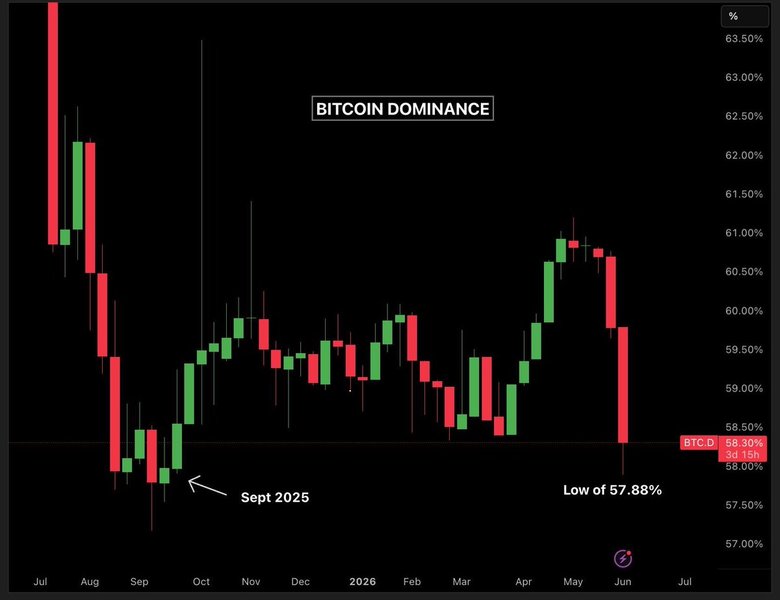
A chart illustrating Bitcoin dominance dropping below a key support level, signaling potential shifts in market dynamics.
2026 Catalysts: The AI-Stablecoin Nexus and Beyond
The Transformative Power of Autonomous Payments and Digital Dollarization
The convergence of artificial intelligence and stablecoin technologies is arguably the most structurally significant development shaping the crypto market in 2026. AI agents are increasingly leveraging blockchain infrastructure for autonomous payments, creating a burgeoning demand for stablecoin settlement rails. This synergy is transitioning from theoretical discourse to tangible operational deployments, with executives anticipating that AI agents and large corporations will spearhead the next phase of stablecoin expansion.
The AI sector within crypto has demonstrated remarkable resilience, outperforming the general crypto market even amidst broader downturns. For instance, in Q1 2026, the AI sector posted significantly smaller losses compared to the wider market. Stablecoins, meanwhile, have continued their robust growth trajectory, reaching new all-time highs in market capitalization. This consistent demand for dollar-denominated on-chain payments underscores their utility as a critical component of the digital economy, largely decoupled from Bitcoin's price fluctuations.
The operationalization of stablecoin cross-border payment volumes, a concept discussed in 2025, has become a practical reality in 2026. This development not only creates persistent demand for these digital assets but also introduces new liquidity vectors that are reshaping traditional market-making dynamics and facilitating instantaneous, machine-to-machine financial transactions.
This radar chart visualizes the current and projected outlook for various factors influencing the crypto market in 2026, highlighting areas of high growth such as Tech Convergence and Institutional Adoption, alongside areas requiring further development like Regulatory Clarity.
Market Architecture and Liquidity Implications
The Maturation of Crypto Infrastructure
The first half of 2026 has been marked by market consolidation and a more selective approach to capital allocation. While the total crypto market capitalization experienced a downturn in Q2 2026, stablecoin market capitalization continued its ascent, indicating that significant capital remains within the crypto ecosystem, rather than exiting entirely. This internal retention of capital suggests a fundamental belief in the long-term viability of digital assets.
Decentralized exchanges (DEXs) are projected to capture an increasing share of spot trading volume. Their appeal to market makers lies in reduced friction and, in some cases, no-KYC access, fostering a more agile trading environment. This shift towards DEXs reflects a broader trend of decentralized finance (DeFi) infrastructure maturing and offering increasingly competitive alternatives to centralized platforms.
Furthermore, consistent inflows into spot Bitcoin ETFs underscore growing institutional adoption, providing a structural underpinning to the market. This institutional engagement helps moderate the severity of downturns compared to previous "crypto winter" scenarios, indicating a more resilient market structure.
This bar chart compares the quarterly growth trends of the overall crypto market, stablecoins, and AI-related tokens, showcasing the relative resilience and outperformance of stablecoins and AI-linked assets.
Strategic Positioning Framework for 2026
Identifying Resilient Themes in a Volatile Market
In the current dynamic environment, effective portfolio construction necessitates explicit consideration of three converging narratives: stablecoin infrastructure, artificial intelligence integration, and tokenization protocols. Projects positioned at the intersection of these themes are demonstrating structural resilience and potential for outperformance relative to broader market movements. Investors are increasingly seeking assets that offer tangible utility, address real-world problems, and align with the future of digital finance.
This mindmap illustrates the interconnected factors shaping the crypto market in 2026, highlighting macroeconomic influences, market dynamics, key technological catalysts, and strategic considerations for participants.
Summary of Key Market Metrics (July 2026)
The table below provides a snapshot of critical metrics influencing the cryptocurrency market as of July 2026, offering context to the prevailing trends discussed.
| Metric | Value (July 2026 Est.) | Trend | Relevance & Implications |
|---|---|---|---|
| Bitcoin Dominance | ~56-58% | Slightly Decreasing / Consolidating | A crucial indicator for broader market sentiment and potential altcoin rotation. Lower dominance often signals increased altcoin activity. |
| Total Crypto Market Cap | ~$2.1 Trillion | Consolidating after Q2 downturn | Reflects overall market health; despite recent fluctuations, capital remains largely within the ecosystem. |
| Stablecoin Market Cap | ~$300-325 Billion | Increasing, All-Time Highs | Demonstrates sustained demand for on-chain dollar-denominated assets, crucial for liquidity and new financial rails. |
| AI & Stablecoin Integration | High Growth Trajectory | Emerging as Key Catalyst | Driving innovation in autonomous payments, enterprise blockchain adoption, and resilient sector performance. |
| Institutional ETF Inflows | Steady/Consistent | Supportive | Provides structural support, moderating market volatility and signaling long-term confidence from traditional finance. |
The Intersection of AI and Crypto: A Deeper Dive
Why Autonomous Systems Need Blockchain
The burgeoning field of artificial intelligence is creating unprecedented demand for efficient, secure, and automated payment systems. This is where blockchain, and specifically stablecoins, become indispensable. AI agents, designed to perform tasks autonomously, require mechanisms to pay for services, data, or even other AI operations without human intervention. Traditional financial systems are often too slow, too centralized, or too costly for these micro-transactions and high-frequency automated interactions.
Stablecoins, pegged to fiat currencies like the US dollar, offer the stability and predictability that volatile cryptocurrencies often lack, making them ideal for programmatic payments. When an AI agent needs to access a specific dataset from a decentralized data marketplace, or pay for computational resources on a distributed network, stablecoins facilitate these transactions seamlessly. This eliminates the need for manual reconciliation, reduces latency, and enhances the overall efficiency of autonomous financial operations.
This integration is not merely about payments; it's about establishing a new paradigm for economic interaction. AI-powered decentralized autonomous organizations (DAOs) could manage treasuries, execute complex financial strategies, and even govern entire ecosystems using stablecoins as their primary medium of exchange. The resilience of the AI token sector, even during broader market corrections, underscores the market's recognition of this profound synergistic potential.
Conclusion
The cryptocurrency market in 2026 stands at a critical juncture, shaped by powerful macroeconomic forces emanating from central bank policies, the dynamic interplay of Bitcoin and altcoin markets, and the revolutionary convergence of artificial intelligence with stablecoin technology. This era is characterized not merely by speculative fervor but by genuine innovation, institutional maturation, and the development of robust infrastructure. As the digital asset landscape continues to evolve, a deep understanding of these interconnected themes will be indispensable for all participants navigating its inherent volatility and unlocking its profound potential.

Thank you for your encouraging comment. Please continue to follow all the latest updates on the site. Regards, The Earn News Team.
Can't post here? Comment in a new window